
For decades, projector headlights meant one thing: a lens, a bulb, and a cutoff shield that kept light out of oncoming drivers’ eyes. That was it. A simple optical tool. But something shifted in the last two years. The humble headlight is no longer just a lighting device—it’s becoming a communication hub, a safety assistant, and in some cases, even a projector for movies.
This isn’t science fiction. These technologies are rolling out in production vehicles today. And if you’re in the market for projector headlights—whether for a car, truck, or bike—understanding where this technology is heading will help you make a smarter buying decision. Let’s look at what’s coming, why it matters, and how GTR fits into this evolving landscape.
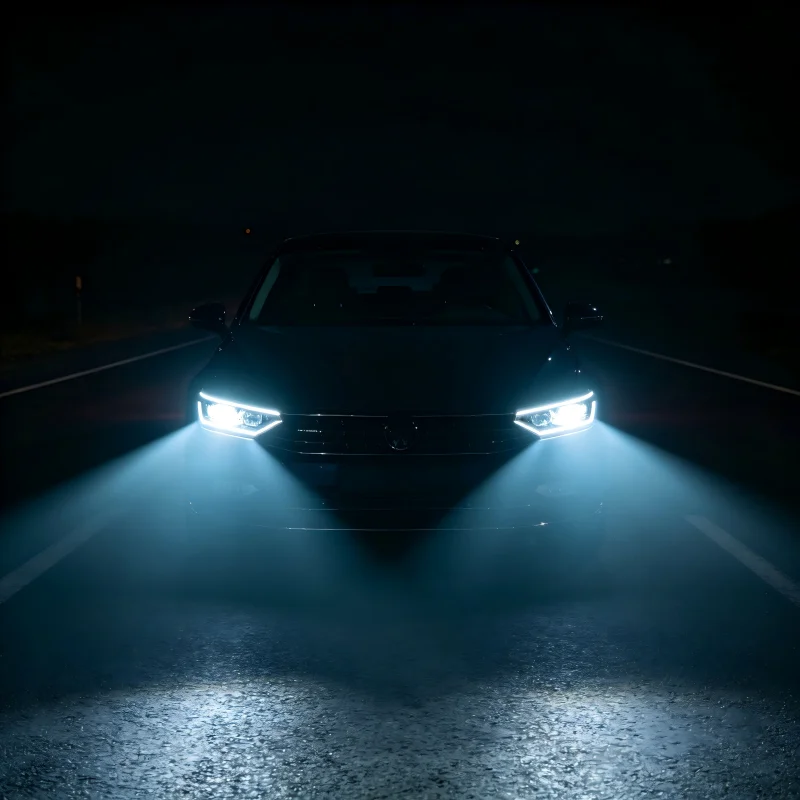
From Fixed Beam to Pixel-Perfect Precision
The biggest shift in projector headlights is the move from analog to digital light sources. Traditional projectors use a single light source—halogen, HID, or LED—paired with a mechanical shield to create the low-beam cutoff. The beam is either on or off. There’s no middle ground.
Digital projectors change that completely. Instead of one bulb, they use arrays of individually controllable pixels—sometimes thousands of them. Each pixel can be dimmed, brightened, or turned off independently. This is the foundation of Adaptive Driving Beam (ADB) technology, also known as matrix or pixel lighting.
Here’s what that means on the road: your high beams stay on all the time. The system detects oncoming traffic and digitally masks out the exact pixels that would hit their eyes, while keeping the rest of the road fully illuminated. No more flashing. No more glare. Just continuous, glare-free high-beam visibility.
In our engineering assessments at GTR, we’ve seen first-generation ADB systems deliver meaningful safety improvements. But the new wave—with 25,000 or even 40,000 pixels per module—is a different league entirely. The precision is extraordinary.
Beyond Illumination: Headlights That Talk
Once you have pixel-level control, you can do more than just light the road. You can project information onto it.
This is where projector headlights are evolving fastest. Systems like Huawei’s XPixel can project navigation arrows, turn-by-turn directions, and lane guidance directly onto the road surface in front of the vehicle. Imagine approaching a complex intersection at night: instead of glancing at a screen, you see the turn arrow illuminated on the asphalt ahead of you. It’s intuitive. It’s safer. And it’s already here.
Some systems go further. Pedestrian yielding modes project crosswalk indicators or “safe to cross” arrows onto the ground, communicating directly with people outside the vehicle. Others support “lighting carpet” effects that follow the curve of the road, giving drivers a preview of upcoming bends.
These aren’t gimmicks. They’re practical safety features that reduce cognitive load while driving—and they’re only possible because of the underlying projector architecture.
From Monochrome to Full-Color: The Entertainment Angle
Here’s where things get interesting—and a little controversial.
Earlier this year, Huawei demonstrated a full-color projection system built into car headlights. The system can project a 120-inch image onto a wall 23 feet away, with 1,200 lumens of brightness and color reproduction that exceeds HDTV standards. We’re talking about turning the front of your car into a drive-in movie projector.
Is this necessary? Probably not. But it signals something important: projector headlights are becoming platforms, not just components. The same hardware that projects movies can also project safety warnings, communication signals, and personalized welcome animations when you approach your vehicle.
This convergence of illumination, communication, and personalization is the defining trend of the next generation of projector headlights. And it’s happening faster than most people realize.
What This Means for Your Next Purchase
If you’re shopping for projector headlights today, here’s how to think about the future without getting paralyzed by it.
1. Don’t Wait for “Perfect” Technology
The pixel-based systems described above are available now—but they’re primarily in premium vehicles and come with premium price tags. For most drivers, a high-quality LED projector with a clean beam pattern and reliable construction is still an enormous upgrade over factory halogens. The gap between “good” and “perfect” is smaller than the gap between “bad” and “good.”
2. Prioritize Beam Quality Over Pixel Count
More pixels don’t automatically mean better lighting. Optical efficiency, driver performance, thermal management, and manufacturing quality all matter just as much—if not more. A 10,000-pixel system with poor optics will underperform a 1,000-pixel system with excellent optics. In our testing, we consistently see that beam pattern accuracy and light distribution uniformity are the strongest predictors of real-world visibility.
3. Consider Upgrade Paths
Some newer ADB systems are designed with modularity in mind. Nichia’s DominoPLS platform, for example, allows manufacturers to upgrade to adaptive beam control without retooling entire lamp housings. While this matters more at the OEM level, it’s worth knowing that the industry is moving toward more flexible, software-defined lighting architectures.
The Role of Regulation
One factor that often gets overlooked is regulation. Adaptive driving beam technology has been legal in Europe for years but only received approval in the U.S. in 2022. Other markets are at various stages of adoption. If you’re in a region where ADB isn’t yet approved, the hardware may still be worth having—it’s often a software or firmware limitation, not a hardware one.
That said, the basic projector headlight—with its sharp cutoff and focused beam—remains legal and effective everywhere. You don’t need ADB to benefit from projector technology.
GTR’s Position: Practical Performance Today, Future-Ready Tomorrow
At GTR, we watch these trends closely. Our engineering team tracks developments in MicroLED, DLP, and pixel-array lighting. We test new technologies as they emerge. But we also believe in delivering proven performance today—not promises about tomorrow.
Our current projector headlights are built around premium LED light sources with precision-engineered optics, robust thermal management, and IP67-rated weather sealing. They deliver the sharp cutoff, even beam distribution, and long-term reliability that serious drivers demand. And because we design our housings with modularity in mind, many of our products can accommodate future light source upgrades as the technology evolves.
Whether you need projector headlights H4 fitment for a classic restoration, a rugged set for your Ram 1500, or a compact solution for your bike, GTR offers professional-grade lighting that performs as advertised—no hype, no shortcuts.
Frequently Asked Questions
What is Adaptive Driving Beam (ADB) in projector headlights?
ADB is a system that uses pixel-controlled light sources to keep high beams on continuously while digitally masking light from reaching oncoming vehicles. It relies on cameras or sensors to detect other road users and adjusts the beam pattern in real time, eliminating glare while maximizing visibility.
Are pixel LED projector headlights available for aftermarket purchase?
Some are, but most remain OEM-only for now. The technology is still relatively expensive and complex to integrate. However, as the market grows and costs come down, aftermarket options will become more common.
Do I need ADB to benefit from projector headlights?
No. Even without ADB, a well-designed projector headlight with a quality LED source delivers vastly better visibility and less glare than any reflector-based system. ADB is an enhancement, not a requirement.
How long until full-color projection headlights are common?
Likely 3–5 years in premium vehicles, longer in mass-market cars. The technology exists, but regulatory approval, cost, and consumer demand will determine the adoption curve.
Are projector headlights with pixel technology more reliable?
Reliability depends on the manufacturer, not the technology. Pixel systems have more components (drivers, sensors, control modules), which can introduce additional failure points. That’s why build quality and thermal management matter more than ever.
The Road Ahead
Projector headlights are evolving from simple optical tools into intelligent, communicative systems that enhance safety, reduce driver fatigue, and even enable new forms of interaction between vehicles and their environment. The technology is moving fast—faster than many drivers realize.
But here’s the thing: the best time to upgrade your lighting isn’t when the technology is perfect. It’s when the technology available today is significantly better than what you have now. And for anyone still using halogen reflectors or outdated projector units, that threshold was crossed years ago.
GTR’s projector headlights deliver the performance you need today, with the build quality and engineering that will remain relevant as the industry evolves. No gimmicks. No vaporware. Just better light, right now.
Ready to see what great lighting looks like? Visit www.rhgtr.in to explore our full range of projector headlights for cars, trucks, and motorcycles. Drive smarter. Drive safer. Upgrade with GTR.