
A low beam headlight should do something simple: help you read the road before the road becomes a problem. Yet many lighting systems fail in a less obvious way. They look bright from outside the vehicle, but they do not give the driver enough useful contrast, width, or forward information once the road becomes dark.
That gap between “bright” and “useful” is where many headlight purchases go wrong.
For drivers, retrofit shops, wholesalers, and automotive lighting distributors, the better question is not how much light a headlamp produces. It is how well that light helps the driver make decisions at night.
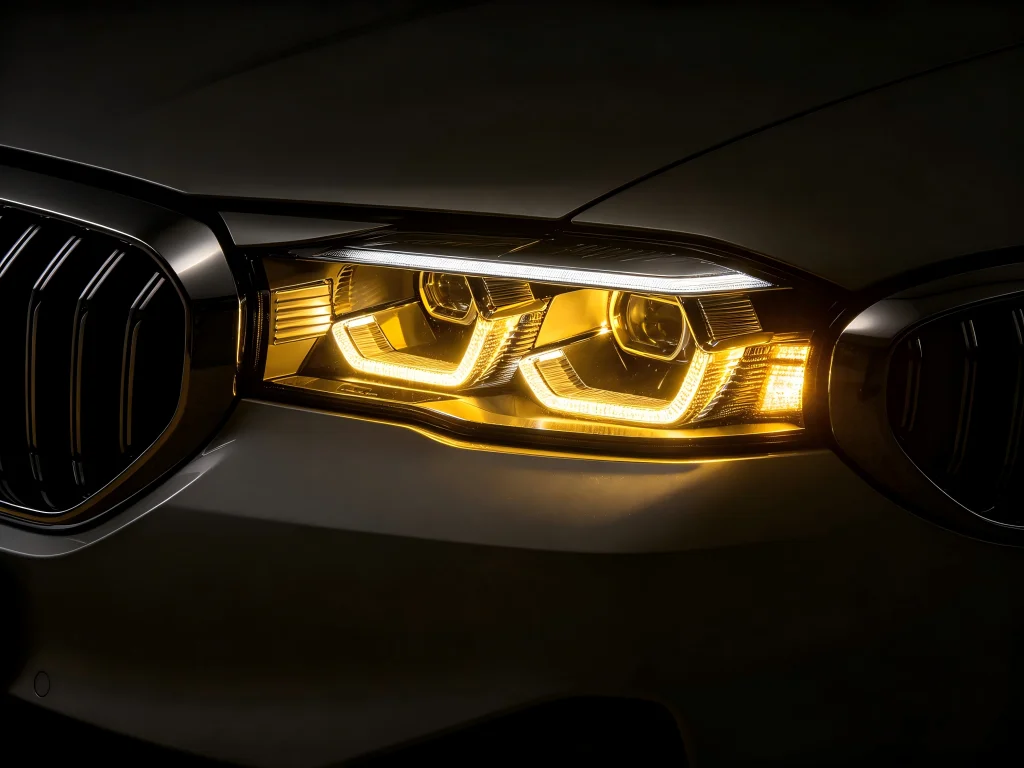
What Should a Low Beam Headlight Actually Do?
A low beam headlight should illuminate the lane, road edge, signs, markings, and nearby hazards while controlling upward glare. Its real performance depends on beam shape, optical focus, aiming, light-source position, electrical stability, and the condition of the complete headlamp—not on lumen output alone.
Think about night driving as a chain of events.
You first need to detect an object. Then you need to understand what it is. Next, you decide whether to brake, steer, or continue. Finally, the vehicle needs enough distance to complete that action.
If the headlight delays the first step, every step that follows becomes harder.
This is why low beam headlights distance at night matters. But distance by itself is still not enough. A narrow bright spot far ahead may be less useful than a balanced beam that reveals lane boundaries, pedestrians, curves, and road shoulders.
The 5 Zones Every Low Beam Should Help You Read
Instead of judging a headlamp as one large patch of light, divide the road into five visual zones.
Zone 1: Immediate Foreground
This is the pavement directly in front of the vehicle.
You need some illumination here, but too much can become a problem. A very bright foreground causes the driver’s eyes to adapt to that high intensity. The darker area farther ahead may then appear even darker.
This is a common reason an LED upgrade can feel impressive at low speed but disappointing on a highway.
Zone 2: Main Driving Lane
This is where the vehicle spends most of its time.
Light should be reasonably even, without large dark areas or distracting patches. Strong central illumination is useful, but it should not sacrifice the rest of the driving field.
Zone 3: Road Shoulders
The side of the road often contains information the driver needs early.
Pedestrians, bicycles, animals, parked vehicles, junctions, and road signs may first appear outside the lane center.
Beam width therefore deserves far more attention than many product listings give it.
Zone 4: Forward Recognition Area
This is the area where the driver begins identifying hazards at speed.
When users search for low beam headlights distance, this is usually the zone they care about most.
But useful reach depends on both illumination and contrast. Light that scatters in the wrong direction may produce less practical visibility even if the total output is high.
Zone 5: Glare-Control Area
Not all light should reach the driver’s field of vision.
Low beams need to control upward light so approaching drivers are not exposed to unnecessary glare.
That is why good low-beam engineering is a balancing exercise rather than a competition for maximum brightness.
Low Beam Headlights vs High Beam Headlights: Different Jobs
Low beam headlights are designed for routine nighttime driving where other road users may be present. High beams send more light farther ahead for dark, open-road conditions. Low beams therefore need stronger glare control, while high beams focus more heavily on long-range forward visibility.
| Performance Area | Low Beam Headlights | High Beam Headlights |
|---|---|---|
| Main use | Normal nighttime traffic | Dark roads with limited surrounding traffic |
| Beam orientation | Downward and controlled | Forward and longer reaching |
| Glare management | Essential | Less restrictive during proper use |
| Road width | Important for lane and shoulder awareness | Usually secondary to distance |
| Driver priority | Balance and control | Maximum useful forward reach |
| Typical indicator | Green symbol | Blue symbol |
This explains why judging low beam headlights vs high beam headlights by the same criteria produces poor buying decisions.
A strong high beam may impress through distance. A strong low beam must manage distance, width, foreground, cutoff, and glare at the same time.
Low Beam Headlights Must Be Bright Enough to See How Many Feet?
There is no single worldwide distance that applies to every low beam headlight. General driving guidance often describes low-beam visibility in a range of roughly 130 to 200 feet, but regulations and test methods vary. Vehicle speed, beam design, road conditions, aim, weather, and driver vision also affect practical seeing distance.
This keyword is common because drivers want one easy number.
Real headlight engineering is more complicated.
A road is not a laboratory wall. It has curves, wet surfaces, elevation changes, reflective signs, lane markings, roadside objects, and traffic.
For legal or technical requirements, consult the relevant authority in your intended market. In the United States, automotive lighting requirements can be researched through NHTSA. Markets using UNECE-based regulations may follow different photometric requirements.
Why Low Beam Headlights Can Look Bright Yet Perform Poorly
One of the most misleading headlight tests happens in a parking lot.
You install a new LED bulb.
You switch it on.
The wall becomes dramatically brighter.
The upgrade looks successful.
Then you drive at night and discover that the beam is patchy, short, or distracting.
Several engineering issues may explain the difference.
The Light Source Is in the Wrong Position
A reflector or projector is designed around a defined light-source location.
When LED emitters do not reproduce that location closely enough, the optical system may redirect light differently than intended.
The result can include:
- Reduced beam distance
- Scattered light
- A weak or distorted cutoff
- Bright spots close to the vehicle
- Dark areas in critical driving zones
- More glare toward other traffic
The Headlight Is Aimed Incorrectly
A technically good headlamp can still perform badly if it points in the wrong direction.
If aimed too low, useful reach decreases.
If aimed too high, glare increases.
Vehicle load, suspension changes, collision repairs, and headlight replacement can all affect alignment.
The Lens Is Reducing Optical Efficiency
A cloudy headlight lens scatters light before it reaches the road.
Increasing bulb output behind a degraded lens may simply create more scattered light.
That is why headlight diagnosis should begin with the complete system rather than the bulb alone.
The Rain Test: Where Weak Low Beams Reveal Themselves
Dry city roads are forgiving.
Wet rural roads are not.
Rain changes reflections and reduces visual contrast. Dark asphalt can absorb more useful light, while reflective signs and approaching headlights may create additional visual distraction.
Under these conditions, a poorly distributed beam often becomes obvious.
A driver may notice:
- Lane markings disappearing sooner than expected
- Road edges becoming difficult to identify
- Bright reflections from wet surfaces
- Excessive glare from signs
- A narrow tunnel-like field of vision
This is why professional lighting evaluation should include more than a showroom demonstration.
What Does the Low Beam Headlights Symbol Mean?
The low beam headlights symbol usually appears as a green headlamp icon with several lines angled downward. It indicates that the vehicle’s dipped or low-beam headlights are active. The high-beam indicator is normally blue and uses straighter light lines pointing forward.
The distinction becomes especially relevant on modern vehicles equipped with automatic lighting and daytime running lights.
A driver may see front lights operating and assume the full nighttime system is active.
That is not always the case.
When Must Low Beam Headlights Be Turned On?
The exact answer depends on local traffic law.
In general, low beam headlights must be turned on for normal nighttime driving. Many regions also require headlights when visibility is reduced by rain, fog, smoke, tunnels, or other conditions.
High beams should only be used when they will not create excessive glare for approaching or preceding road users.
For vehicle owners and distributors, this legal variation matters because lighting products may be sold into many different markets.
Why Color Temperature Can Mislead Buyers
Consumers often describe a cooler white LED as “brighter” even when measured road performance tells a more complex story.
That perception influences the aftermarket.
A product with a very high Kelvin number may look modern, but color temperature alone does not tell you:
- How far the beam reaches
- How much light reaches the shoulder
- Whether the cutoff is controlled
- How stable the output remains when hot
- Whether the lamp works well in rain
In our manufacturing experience, optical distribution and thermal stability usually provide more meaningful product differentiation than simply chasing a colder-looking light color.
Why Thermal Performance Changes Night Driving
LED output is affected by heat.
That makes thermal engineering part of headlight performance rather than just a reliability issue.
Consider a bulb that looks extremely bright during the first minute after startup.
As temperature rises, the driver electronics may reduce power to protect the LEDs. The output then falls.
For a ten-minute demonstration, the bulb looks excellent.
For a three-hour night drive, the story may be different.
What Professional Buyers Should Request
When evaluating samples, ask suppliers about:
- Startup power
- Operating power after thermal stabilization
- Heat-sink design
- Fan specification where applicable
- LED board thermal path
- Driver operating temperature
- Long-duration output stability
This type of evaluation is especially useful for distributors because weak thermal design may later appear as customer complaints or premature failure.
A Headlight Should Be Tested Like a System
Buyers often isolate one specification at a time.
That makes comparison easier, but it can also hide problems.
A better evaluation uses a system-level scorecard.
| Test Area | What to Check | What a Poor Result May Cause |
|---|---|---|
| Optical focus | Emitter position and beam consistency | Scatter and dark zones |
| Beam width | Lane and shoulder coverage | Narrow visual field |
| Cutoff | Upper beam control | Glare |
| Thermal stability | Output after extended operation | Brightness drop |
| Mechanical fit | Space, clips, dust cover | Installation problems |
| Electrical behavior | Flicker, warnings, startup | Compatibility complaints |
| Production consistency | Multiple sample comparison | Batch-to-batch variation |
Low Beam Headlight for 2015 Chevy Equinox: Why Fitment Needs Verification
The search term low beam headlight for 2015 Chevy Equinox illustrates a wider aftermarket problem.
Many customers assume that model year alone guarantees the correct replacement.
It may not.
Headlamp configuration can vary by trim, regional specification, factory equipment, and previous modifications.
Before confirming an application, verify:
- Vehicle year
- Trim level
- Original headlamp assembly
- Bulb base
- Connector type
- Available cooling clearance
- Dust-cover depth
- Electrical compatibility
This matters even more in B2B sales.
A wrong fitment on one consumer order creates one return.
A wrong fitment across a distributor’s catalog can create hundreds.
The Three Headlight Buyers You Should Never Treat the Same
The Daily Driver
This buyer wants safer and clearer night visibility without complicated installation.
The priorities are usually:
Beam quality, ease of installation, reliability, reasonable brightness, and reduced glare.
The Professional Retrofit Shop
This buyer thinks differently.
Installation time matters because labor is part of the product cost.
A technically good lamp that requires twenty extra minutes of modification may be less attractive than a slightly more expensive product with better fitment.
The Distributor or Brand Owner
This buyer is purchasing a business outcome.
They need:
- Consistent performance
- Stable supply
- Low return rates
- Packaging options
- Application support
- Reliable quality control
- A product story that dealers can actually sell
This is where supplier selection becomes more important than one specification.
What Experienced Drivers Usually Learn After Several Upgrades
A common pattern appears across enthusiast forums and aftermarket communities.
First-time buyers often focus on maximum brightness.
Experienced buyers tend to talk more about beam shape.
A typical discussion sounds like this:
“My first bulbs looked insanely bright in photos, but most of the light stayed close to the car. The second setup had a cleaner pattern and didn’t look as dramatic on the wall, but I could actually read the road farther ahead.”
This is an illustrative summary of common user experiences, not a quotation from a named customer.
The lesson is useful for both consumers and wholesalers:
visual drama is not the same as driving performance.
How GTR Approaches Low Beam Development
At GTR, we view an automotive lighting product as a combination of optics, electronics, thermal management, mechanical structure, and application fit.
Changing one part affects the others.
More power creates more thermal demand.
A larger heat sink may create installation issues.
A different LED package may change focal geometry.
A more compact design may require more careful driver engineering.
That system-level approach is especially important for B2B buyers who cannot afford to evaluate products only from packaging claims.
Depending on the program, GTR can support automotive aftermarket wholesalers, distributors, retrofit chains, and brand customers with product selection and customized lighting solutions for different applications.
FAQ About Low Beam Headlights
What are low beam headlights used for?
Low beams are the normal headlights used for nighttime driving around other traffic. They illuminate the road while limiting upward light that could cause glare.
Low beam headlights must be bright enough to see how many feet?
There is no universal global number. General driving references often mention roughly 130 to 200 feet, but vehicle standards, road rules, headlamp designs, and test methods vary by market.
Low beam headlights should illuminate objects at a distance of at least how far?
The answer depends on the jurisdiction and the type of guidance being referenced. For vehicle compliance, buyers should use the applicable technical standard rather than relying on a generic driving-test figure.
What is the difference between low beam headlights vs high beam headlights?
Low beams prioritize controlled illumination and glare reduction. High beams provide stronger long-distance visibility when surrounding traffic conditions allow their use.
What does the low beam headlights symbol look like?
The low beam headlights symbol is usually green and shows a headlamp with lines angled downward. The high-beam symbol is commonly blue.
Why are my low beam headlights weak at night?
Possible causes include cloudy lenses, incorrect aim, aging light sources, voltage loss, poor LED optical compatibility, deteriorated reflectors, or excessive foreground light.
Can very bright LEDs reduce practical night visibility?
Yes. If extra output is concentrated too close to the vehicle or scattered outside useful zones, the driver’s eyes may adapt to the bright foreground while distant areas become harder to see.
Should a distributor test several samples?
Yes. Multiple samples help reveal production variation in output, beam pattern, assembly position, driver performance, and thermal behavior before a large order is approved.
Your Customer Does Not Buy Lumens. They Buy Confidence at Night.
When a driver turns onto an unlit road, the number printed on the box disappears.
Only the beam remains.
That beam needs to reveal the lane.
It needs to expose the shoulder.
It needs to give the driver enough time to recognize danger.
And it needs to do all of that without turning every approaching vehicle into a glare complaint.
That is the standard a serious low beam headlight should be designed around.
If you are building a new automotive lighting range for wholesale, retrofit shops, regional distribution, or your own aftermarket brand, evaluate the road performance before you evaluate the carton. Visit www.rhgtr.in and talk with GTR about low-beam and automotive lighting solutions designed around application fit, optical control, thermal stability, and repeatable B2B quality.