
A led light fog lamp can look excellent on a specification sheet and still perform poorly once installed on a real vehicle. Why? Because fog-light performance is created by an entire system: the LED emitter, optics, driver electronics, cooling structure, housing, vehicle voltage, installation angle, and weather conditions all influence the final beam.
For drivers, that difference determines whether an upgrade actually improves road visibility. For wholesalers and automotive lighting distributors, it can determine something even more important: whether a product becomes a profitable SKU or a warranty problem.
So instead of beginning with lumens, watts, or price, this guide follows a different path.
We will take an LED fog light from the specification sheet to the road and examine what should be verified at every stage.
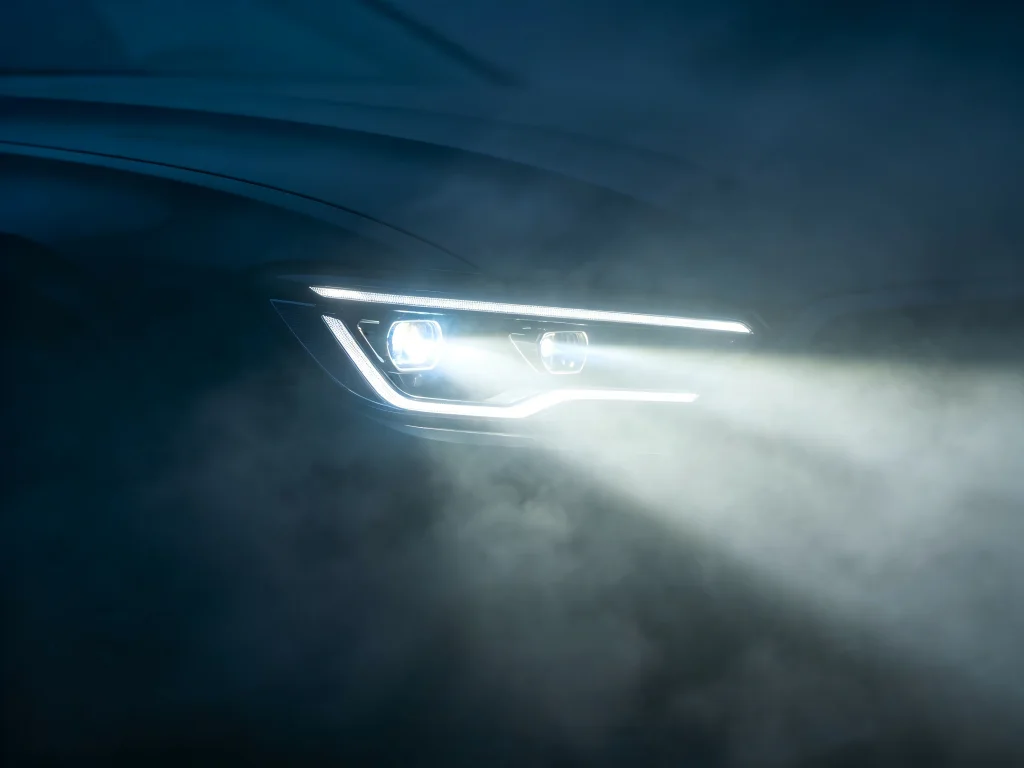
What Makes a Good LED Light Fog Lamp?
A good LED fog lamp should create controlled near-road illumination, maintain stable output as temperature rises, fit the original lamp correctly, resist water and vibration, and operate reliably with the vehicle’s electrical system. High advertised brightness alone cannot guarantee better fog-light performance on the road.
Think about an LED fog light as six connected layers:
- The LED light source generates illumination.
- The bulb geometry places that source inside the correct optical area.
- The original reflector or projector shapes the light.
- The cooling system controls LED temperature.
- The electronic driver regulates electrical power.
- The vehicle and environment determine how the complete system performs.
If one layer fails, the result changes.
This explains why two LED bulbs using similar LED chips can produce completely different road performance.
Stage 1: Start With the Vehicle, Not the LED Bulb
The first step when selecting an LED fog-light replacement is confirming the exact vehicle application. Buyers should identify the original bulb type, connector, housing design, installation clearance, electrical system, and factory lighting package before comparing brightness or color temperature.
This sounds basic, yet fitment is one of the most underestimated parts of aftermarket automotive lighting.
A customer might search for:
led fog light bulb for car
That search tells us very little.
The buyer still needs to know the vehicle make, model, production year, trim, lighting configuration, original bulb socket, and sometimes the regional specification.
For a distributor carrying hundreds of vehicle applications, these details become part of inventory management.
Why Application Accuracy Has a Financial Value
Imagine a wholesaler sells 2,000 bulbs during a season.
If only a small percentage are returned because of incorrect application information, the actual cost extends beyond replacement bulbs.
It may also include:
- Customer-service time
- Return shipping
- Distributor handling costs
- Negative marketplace reviews
- Installer complaints
- Lost repeat business
For this reason, professional product sourcing should begin with application accuracy rather than packaging claims.
Stage 2: Check the LED Emitter Position
The next question is not how bright the LED chip is.
It is where the chip sits.
Halogen fog-light housings were normally designed around a filament located in a specific position. The reflector collects light from that area and redirects it toward the road.
When a replacement LED places its emitters too far forward, backward, or sideways, the reflector receives light from a different location.
The optical result may change immediately.
Instead of a controlled pattern, the road may show:
- Bright central hotspots
- Dark areas
- Excessive upward scatter
- Poor side illumination
- An uneven left-right beam
This is why LED package dimensions deserve serious attention.
Based on our automotive lighting manufacturing experience, emitter geometry can be just as important as raw LED power when developing replacement lighting products.
A Simple Rule for Evaluating LED Geometry
The closer the effective LED light source is to the optical position expected by the original lamp, the better the chance that the existing reflector can control the light effectively.
That does not mean every compact LED will automatically work.
It means optical compatibility should be tested rather than assumed.
Stage 3: Put the Beam on a Wall Before Putting It on the Road
A beam-pattern test can reveal problems that lumen figures cannot show. A useful LED fog-light beam should illuminate the low foreground and road edges while limiting excessive upward scatter. Compare the LED against the original lamp from the same distance, housing, voltage, and aiming position.
A controlled wall test is one of the easiest ways to identify optical problems.
The process is simple:
- Park the vehicle on level ground.
- Position it at a fixed distance from a flat wall.
- Mark the original fog-light beam.
- Photograph the halogen reference pattern.
- Install the LED replacement.
- Repeat the test without changing vehicle position.
- Compare beam width, hotspot location, vertical scatter, and symmetry.
The goal is not to determine which photograph looks brighter.
The goal is to determine whether the LED delivers useful light into the correct area.
Stage 4: Measure Useful Light, Not Marketing Light
One of the most confusing parts of the automotive LED market is lumen advertising.
Some figures may represent theoretical LED chip output. Others may describe total output from a pair of bulbs. Some may represent estimated rather than independently measured performance.
That makes direct comparisons difficult.
| Specification | What Buyers Often Assume | What Should Actually Be Checked |
|---|---|---|
| Lumens | Higher number means better visibility | Usable output and beam distribution |
| Watts | Higher wattage means brighter light | Electrical efficiency and thermal stability |
| Color Temperature | Whiter light means better performance | Weather conditions and beam quality |
| LED Chip Brand | Premium chip guarantees a premium bulb | Complete optical and thermal design |
| Rated Lifespan | The bulb will operate for the stated hours | Operating temperature and driver quality |
| CANBUS | Works with every modern vehicle | Actual compatibility with target platforms |
A professional buyer should therefore ask one key question:
How does the product behave after installation?
That question is much harder to manipulate than a specification table.
Stage 5: Run the LED Until It Gets Hot
An LED fog bulb that looks impressive during a two-minute demonstration may behave differently after forty minutes of continuous use.
LED chips create heat at their semiconductor junction.
If that heat cannot escape efficiently, junction temperature rises. The driver circuit may then reduce current to protect the LED.
This process is often called thermal regulation.
From a reliability perspective, thermal regulation is useful. It can protect the product.
From a performance perspective, however, the important question is how much brightness remains after the system reaches thermal equilibrium.
The Test B2B Buyers Should Request
Instead of asking only for maximum initial output, ask the supplier to test the bulb continuously.
Useful checkpoints may include:
- Startup
- 10 minutes
- 30 minutes
- 60 minutes
- Stable operating condition
If the output drops sharply after temperature rises, the specification-sheet number does not represent typical road use.
At GTR, we view heat management as part of optical performance because an LED cannot maintain useful illumination if the thermal system cannot support the operating power.
Stage 6: Understand H11 and H8 Before Ordering Inventory
The searches led fog light bulb h11 and led fog light bulb h8 appear frequently because both bulb types are widely associated with automotive lighting.
They also create confusion.
H8, H9, H11, and some related configurations can appear mechanically similar. Certain aftermarket LED designs may serve multiple sockets.
That does not mean a buyer should automatically treat them as identical.
| Check Before Purchase | Why It Matters |
|---|---|
| Original bulb number | Confirms the basic application |
| Locking tabs | Determines mechanical installation |
| Connector | Prevents electrical mismatch |
| Housing depth | Ensures the heat sink physically fits |
| Original wattage | Helps evaluate electrical compatibility |
| Vehicle monitoring system | May affect warning lights or flicker |
For distributors, a clearly defined H8/H11/H16 application strategy can reduce SKU confusion while still maintaining correct fitment information.
Stage 7: Test the Electronics Inside the Vehicle
The LED driver is easy to ignore because customers cannot see it.
Yet it has a major influence on product reliability.
The electrical environment inside a vehicle is not the same as a stable laboratory power supply.
Voltage can change. Engines start. Alternators operate. Electronic modules monitor circuits. Different manufacturers use different bulb-detection strategies.
A strong LED driver should be designed to operate reliably within the intended automotive environment.
Common Compatibility Symptoms
When electronics and vehicle systems do not communicate well, customers may report:
- LED flickering
- Bulb-out dashboard warnings
- Lights turning off unexpectedly
- Uneven startup behavior
- Radio interference
Some applications may benefit from CANBUS-compatible solutions or additional components.
However, the term “CANBUS ready” should never be treated as a universal guarantee.
Actual vehicle testing remains more valuable.
Stage 8: Choose Color Temperature for the Road Environment
Color is often sold as a styling decision.
For fog lighting, it can also be an application decision.
| Approximate CCT | Appearance | Typical Buyer Priority |
|---|---|---|
| 2700K–3000K | Deep warm yellow | Poor-weather visibility preference |
| 3000K–4000K | Yellow to warm white | Mixed weather use |
| 4300K–5000K | Neutral white | Balanced road lighting |
| 5500K–6000K | Clean white | Modern OEM-style appearance |
| 6500K+ | Cool white | Primarily styling-driven preference |
Many customers like 6000K because it matches modern LED headlights.
Other drivers prefer warm yellow during rain, snow, or fog.
Neither choice can compensate for poor beam control.
A correctly controlled white fog light can be far more useful than a scattered yellow one.
Stage 9: Take the LED Fog Light Into Real Weather
Laboratory tests tell us a great deal.
They cannot reproduce every driving condition.
A serious led light fog lamp car evaluation should also consider what happens when pavement is wet.
Wet asphalt reflects light differently from dry pavement. Road spray reduces contrast. Fog increases backscatter. Snow can create its own reflective surface.
During road testing, evaluate more than apparent brightness.
Ask:
- Can you identify the road edge earlier?
- Does foreground illumination feel balanced?
- Does the beam create distracting glare?
- Are potholes and surface changes easier to identify?
- Does wet pavement reduce useful contrast?
- Does the color temperature remain comfortable after extended driving?
These observations provide information that package specifications cannot.
Stage 10: A Bike LED Light Fog Lamp Needs a Different Test
A bike led light fog lamp should not simply be treated as a smaller version of a car lamp.
Motorcycles create different mechanical conditions.
The lamp or bulb may experience more noticeable vibration. Auxiliary lights may be mounted directly on brackets. Products can face water spray, dust, stones, and repeated impact from rough roads.
For an led fog light bulb for bike or a complete motorcycle auxiliary lamp, we would examine additional factors:
- Bracket strength
- Fastener retention
- Vibration resistance
- Water resistance
- Harness protection
- Connector sealing
- Beam stability after vibration
Beam stability deserves special attention.
If the lamp gradually changes its aiming angle because of vibration, the rider may lose useful illumination while creating glare for other road users.
Stage 11: Replacement Bulb or Complete Fog Lamp?
Many searches for led fog light bulb replacement come from buyers who want the simplest possible upgrade.
A replacement bulb often makes sense when the original lamp housing remains in good condition.
It keeps installation simple and preserves the vehicle’s factory appearance.
But there is another option.
A complete LED fog lamp allows the LED, optics, housing, cooling system, and lens to be developed together.
| Solution | Replacement LED Bulb | Complete LED Fog Lamp |
|---|---|---|
| Installation | Usually easier | May require more work |
| OEM Appearance | Usually retained | Depends on design |
| Optical Control | Depends on existing housing | Can be engineered as one system |
| Cost | Usually lower | Usually higher |
| Product Differentiation | Moderate | High |
| Best Use | Simple upgrade market | Integrated performance upgrade |
For wholesalers, carrying both product categories may cover different customer groups.
Stage 12: Do a Vehicle-Specific Check — 2019 Ford F-150 Example
The keyword led fog light bulb 2019 ford f150 demonstrates why application-specific SEO and application-specific product development belong together.
A buyer may arrive on a product page expecting a simple answer.
The responsible answer is to verify the exact factory configuration.
Certain 2019 Ford F-150 fog-light applications are commonly associated with 9140/H10-style bulbs rather than H11, depending on configuration. Lighting packages and trim specifications can vary.
That means a seller should avoid assigning applications solely from similar model years or search popularity.
A better product database may include:
- Vehicle year
- Make
- Model
- Trim
- Factory lighting package
- Bulb position
- Original bulb type
- Regional market
This type of data becomes especially valuable for B2B distributors managing large application catalogs.
Stage 13: Ask Whether the Product Can Survive Your Market
A fog light sold in a dry inland region does not face exactly the same environment as one sold in a tropical coastal market.
Temperature, humidity, heavy rainfall, road salt, dust, and traffic conditions may all affect product requirements.
For example, buyers selling into regions with monsoon seasons may place greater emphasis on sealing and corrosion resistance.
Cold-weather markets may prioritize snow performance and resistance to temperature cycling.
Off-road-oriented customers may demand stronger vibration and impact resistance.
The strongest product portfolio is therefore not always the one with the largest number of SKUs.
It is the one matched to actual market conditions.
What Should a Distributor Inspect When Receiving Samples?
When GTR works with professional automotive lighting buyers, sample evaluation is not treated as a beauty contest.
A sample should answer commercial questions.
Before approving a bulk led fog light bulb order, evaluate:
- Mechanical consistency: Do multiple samples lock into the socket with similar force?
- Optical consistency: Are beam patterns similar from bulb to bulb?
- Color consistency: Do left and right bulbs visually match?
- Thermal stability: Does brightness remain acceptable after extended use?
- Electrical behavior: Does startup remain stable across representative vehicles?
- Noise: If a fan is used, is the acoustic behavior acceptable?
- Housing clearance: Does the product fit without modifying vehicle components?
- Packaging accuracy: Is application information clear enough for end users?
This is where B2B buying differs from personal shopping.
A retail customer asks whether one bulb works.
A distributor needs to know whether thousands of bulbs will work consistently.
The Cost Per Bulb Is Not the Real Product Cost
Suppose Product A costs slightly less than Product B.
Product A also creates more fitment questions, more returns, and more warranty claims.
Which product is cheaper?
The answer may be Product B.
Professional purchasing teams can benefit from thinking in terms of total product cost:
Purchase cost + shipping + returns + replacements + customer support + lost sales + reputation cost.
A slightly higher unit price may be commercially stronger when product consistency reduces downstream expenses.
How GTR Builds LED Lighting for Professional Buyers
GTR approaches automotive lighting from the perspective of manufacturing consistency and real aftermarket requirements.
We know distributors are not simply buying LEDs.
They are buying products that must travel through a chain:
factory → importer → wholesaler → installer → vehicle owner.
Every step creates requirements.
The importer needs predictable supply.
The wholesaler needs clear positioning.
The installer needs reliable fitment.
The driver needs useful road performance.
That is why GTR focuses on a combination of optical performance, heat management, electrical design, mechanical fitment, and production consistency.
For professional buyers, we can also support OEM/ODM projects, product configuration, application planning, private branding, packaging development, and market-oriented product portfolios.
Automotive lighting requirements can differ by destination market. Distributors should review applicable national regulations and recognized vehicle-lighting standards before selling retrofit lighting for public-road use. Reference information may be available through organizations such as SAE International.
FAQ: LED Light Fog Lamp Technical Questions
Is an LED light fog lamp better than halogen?
A quality LED system can provide strong efficiency, modern color options, and long potential service life. However, actual performance depends on optical compatibility, heat management, electrical design, and correct installation. A poorly designed LED replacement may perform worse than the original halogen bulb.
Which LED fog light bulb is best for a car?
The best led fog light bulb for car is one designed for the correct bulb socket and housing while providing stable output, controlled beam distribution, suitable dimensions, reliable cooling, and compatible electronics.
Can I use an H11 LED as a fog-light bulb?
Yes, if the vehicle’s fog-light position uses an H11-compatible socket and the LED is suitable for the housing. Always verify the original bulb specification before installation.
Can H8 and H11 LED bulbs be interchangeable?
Some LED products support both H8 and H11 applications because the bulb families share similarities. However, buyers should verify locking tabs, connectors, dimensions, electrical requirements, and vehicle-specific fitment rather than assuming universal interchangeability.
Why do some LED fog lights become less bright after installation?
Thermal regulation may reduce electrical power after the LED reaches a high operating temperature. Effective cooling helps limit excessive output reduction and supports longer component life.
Should fog lights be yellow or white?
Both can work well when the beam is properly controlled. Yellow light is popular for fog, rain, and snow, while white light provides a clean modern appearance and strong general nighttime visibility. Local driving conditions should guide the choice.
Why does an LED fog bulb cause a dashboard warning?
The vehicle may detect the lower electrical load of the LED as a failed bulb. A vehicle-compatible driver, CANBUS solution, or additional electrical component may be required for some applications.
Are motorcycle LED fog lights different from car fog lights?
They can be. Motorcycle lighting often faces more vibration and direct environmental exposure, so mounting strength, water resistance, compact dimensions, electrical load, and beam stability deserve extra attention.
Do Not Approve a Fog Light From a Specification Sheet
There is a simple lesson behind every stage in this guide.
A specification can describe a component.
Only testing can describe its behavior.
The best led light fog lamp is not automatically the product with the largest lumen number, highest wattage, whitest color, or lowest purchase price.
It is the product that continues to perform after installation, after temperature rises, after the road gets wet, and after thousands of units leave the factory.
That distinction becomes critical when you are building a product line rather than buying one replacement bulb.
If you are an automotive lighting wholesaler, importer, retrofit chain, regional distributor, or private-label brand, visit www.rhgtr.in and discuss your target applications with GTR.
Tell us which vehicles you serve, which bulb families your market needs, what weather your customers drive through, and how you plan to position the product. GTR can help turn those requirements into an LED fog-light program built for real roads—not just attractive specifications.