
When you switch on your vehicle’s headlights at dusk, you’re not just illuminating the road ahead. You’re initiating a complex chain of physics, optics, and human visual perception. Every photon that leaves your h7 led headlamp bulbs travels through a precisely engineered optical system, reflects off carefully calculated surfaces, and ultimately determines whether your brain registers a hazard in time to react.
Direct Answer: The performance of H7 LED headlight bulbs depends on three interconnected factors: the optical alignment of LED chips relative to the original halogen filament position, the thermal management system that maintains consistent light output, and the color temperature that optimizes human contrast sensitivity under nighttime driving conditions.
Understanding these principles transforms how you evaluate led light bulbs h7 options. It moves the conversation from marketing claims to engineering reality.
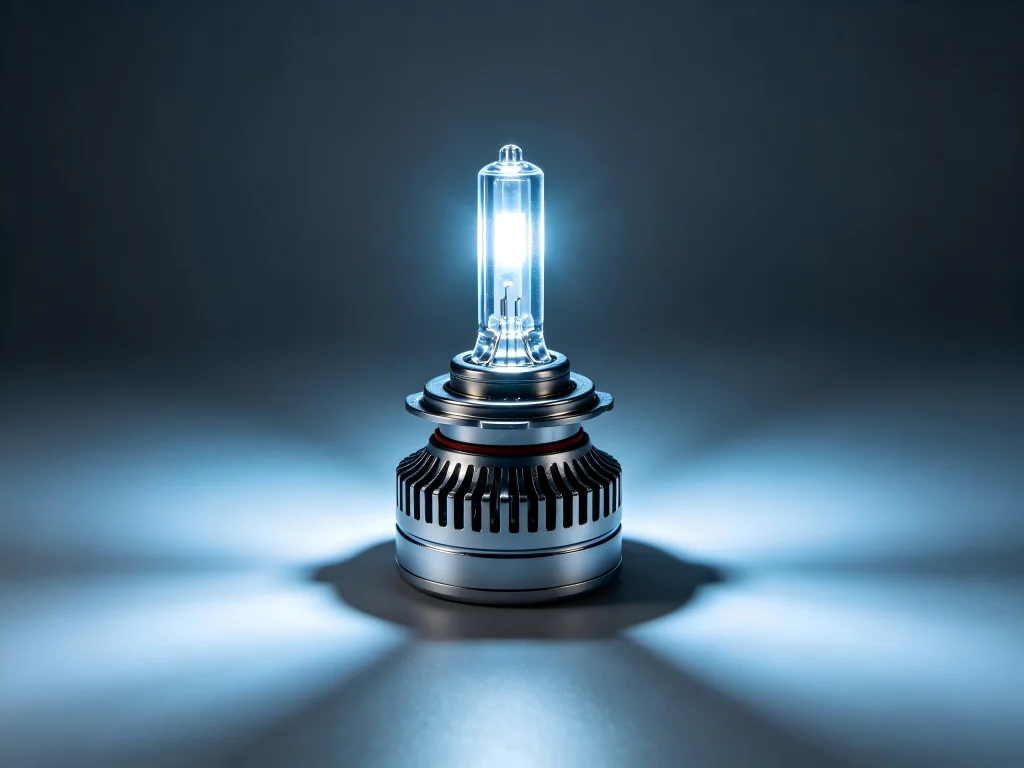
The Optical Journey: From LED Chip to Road Surface
Your headlight housing—whether reflector or projector—is a precision optical instrument. The original halogen H7 bulb contains a filament positioned at a specific focal point relative to the reflector bowl. Every curve of that reflector was calculated to capture light from that exact position and project it onto the road in a controlled pattern.
When you install h7 led headlamp bulbs with chips positioned even a fraction of a millimeter off that focal point, the entire optical system breaks down. Light that should reach the road scatters upward, creating glare. Light that should illuminate the shoulder falls short, creating dangerous dark spots. The beam pattern degrades because the reflector is now trying to focus light from the wrong source position.
This is why the industry has converged on what’s called “1:1 beam pattern technology.” Premium h7 led headlight bulbs replicate the halogen filament position with sub-millimeter precision, using ultra-thin chip spacing—typically 0.03 to 0.04 inches—to ensure the LED emitters sit exactly where the filament would be. The result is a beam pattern that mirrors OEM light distribution, with a sharp cutoff line, minimal glare, and uniform illumination across the road surface.
One driver on a Mercedes forum reported: “Many W211 owners report excellent results with similar H7 LEDs in the low-beam projectors: sharper cutoff, much brighter output, and a clean white pattern without major hotspots.”
Reflector vs. Projector: Why Housing Type Matters
The distinction between reflector and projector housings isn’t just academic—it directly affects which h7 led headlamp bulbs will perform well in your vehicle.
Reflector housings use a curved mirror behind the bulb to shape and direct light. They’re more forgiving of minor position errors but still require precise LED placement to avoid scattering light above the horizon.
Projector housings use a lens and an internal cutoff shield to create a sharp horizontal line between light and shadow. These are less forgiving—if the LED chip position is even slightly off, the cutoff becomes fuzzy and light spills above the horizon. However, projector housings also allow for a brighter light source without risking glare, because the cutoff shield physically blocks stray light.
In independent testing across both housing types, the GTR Lighting Ultra 2 emerged as the brightest bulb tested in both reflector and projector headlights. This performance consistency speaks to the precision of its optical engineering.
The Thermal Challenge: Heat, Light, and Longevity
Here’s a counterintuitive fact: LEDs convert only about 20 to 25 percent of electrical energy into light. The rest becomes heat. If that heat isn’t managed effectively, junction temperatures soar above 150°C, and a bulb rated for 30,000 hours can fail in under six months.
Academic research confirms that elevated p-n junction temperatures lead to reduced luminous efficacy, significantly shortened lifespan, and compromised reliability of LED light sources. The data from manufacturers typically assumes a junction temperature of 85°C during operation, and it must not exceed 150°C.
This is why thermal management separates premium led headlights bulbs h7 from budget alternatives. The market has largely moved away from active cooling (fan-based systems) toward passive cooling solutions that substantially increase reliability and reduce the overall footprint of the kit. Aviation-grade aluminum housings act as convection-style heat sinks, dissipating heat without moving parts that can fail.
In one independent test, a bright but poorly cooled LED bulb ran for just one hour—and the black anodized coating on its heat sink actually burned off. The tester warned: “I can guarantee you you’re going to have similar results running this kind of bulb on your vehicle. Who knows what kind of damage it could create.”
The GTR Ultra 2, by contrast, proved exceptionally resilient in durability testing, maintaining over 75 percent of its output for more than 5,000 hours of continuous operation—earning a Superior rating.
Lumens vs. Lux: What Brightness Actually Means
If you’ve shopped for h7 led headlight bulbs, you’ve seen lumen numbers ranging from 3,000 to 90,000. But these numbers often tell you more about marketing creativity than real-world performance.
Lumens measure total light output from the source. Lux measures light intensity on a specific surface—what actually reaches the road. A bulb can produce impressive lumens but deliver mediocre lux if the beam pattern is scattered.
This is why effective lumens matter more than raw lumens. A bulb quoting 36,000 raw lumens might deliver only 12,000 effective lumens once installed in your headlight housing. Premium manufacturers like GTR publish both figures: the GTR Lighting Ultra 2 delivers 3,350 effective lumens per bulb—light measured where it matters, on the road.
Independent testing confirmed the Ultra 2 delivered up to 709 percent more usable light than a standard halogen bulb. In projector headlight testing, it came in at over 400 percent brighter than the original halogen. These aren’t just numbers on a spec sheet—they represent measurable improvements in road visibility.
Color Temperature and Human Perception
The color temperature of your h7 led headlight bulb affects more than aesthetics—it influences how your eyes perceive contrast and depth at night.
Most premium H7 LED bulbs operate in the 5,000K to 6,500K range. The 6,000K color temperature delivers an ice-white light that mimics daylight and enhances long-range visibility. However, some experts note that higher color temperatures can cause more glare, especially when reflected from wet road surfaces during rain. For this reason, some drivers prefer 5,000K bulbs, which provide a pure white output without the blueish tint of 6,000K options.
GTR’s Ultra 2 uses a 6,000K color temperature that balances the clarity of daylight with practical road visibility. Independent testers noted the color temperature is “very close to that of an OEM Xenon bulb,” making them suitable for drivers seeking a modern, factory-like appearance.
Beyond the Bulb: Canbus, Installation, and Compatibility
Even the best-engineered h7 led headlight bulbs won’t perform if they don’t work with your vehicle’s electrical system. Modern vehicles use Canbus networks to monitor bulb status—and they expect to see the resistance of a halogen bulb. When low-wattage LEDs don’t match that resistance, the computer triggers error codes and flickering.
Premium H7 LED bulbs integrate Canbus decoders that simulate halogen power draw. The best bulbs work out of the box with 99 percent of vehicles, eliminating the need for external resistors or warning cancellers.
Installation should be straightforward with 1:1 halogen-size designs. As one reviewer noted: “Replacement was fairly simple/routine. Pull off the rubber boot under the hood behind the headlight, unplug the old bulb, undo the spring clip and remove the old bulb unit.”
Frequently Asked Questions About H7 LED Headlamp Bulbs
Can you put LED bulbs in halogen headlights?
Yes, provided the LED bulb replicates the halogen filament position with sub-millimeter precision. Bulbs that don’t achieve this create glare and scattered light. Quality H7 LED bulbs like the GTR Ultra 2 are engineered with 1:1 beam pattern technology specifically for halogen housings.
Do LED bulbs work in halogen headlights?
LED bulbs work effectively in halogen headlights when their optical design matches the original light source position. This ensures the reflector or projector lens focuses light correctly. Premium H7 LED bulbs are designed for this purpose and deliver superior performance without compromising safety.
Can I use LED bulbs in halogen headlights without modifications?
Most modern H7 LED bulbs are designed as direct replacements with 1:1 halogen-size form factors. No adapters, spacers, or wiring modifications are required. Some vehicles may need Canbus decoders, but many premium bulbs include them internally.
Why do my H7 LED headlight bulbs flicker?
Flickering is typically caused by Canbus incompatibility—your vehicle’s computer doesn’t recognize the LED’s lower power draw. Quality H7 LED bulbs include built-in decoders that eliminate this issue. If problems persist, check for proper electrical connections or consider a dedicated warning canceller harness.
How long do H7 LED headlight bulbs last?
Premium H7 LED bulbs typically last 30,000 to 50,000 hours of operation—roughly 10 to 15 times longer than halogen bulbs. Proper thermal management is the key factor; bulbs with inadequate cooling can fail within months. GTR backs its Ultra 2 series with a lifetime warranty, reflecting confidence in its thermal engineering.
Are H7 LED headlight bulbs legal?
Legality varies by jurisdiction. In many regions, LED retrofits in halogen housings are legal only if the bulb produces a compliant beam pattern and does not exceed specified brightness limits. Bulbs that create glare or scatter light typically fail inspection. GTR bulbs are engineered to maintain OEM beam patterns for compliance in most markets.
What’s the difference between 5,000K and 6,000K H7 LED bulbs?
The difference is color temperature. 5,000K produces a pure white light without blue tint, which some drivers prefer for reduced glare in wet conditions. 6,000K produces an ice-white light that mimics daylight and enhances long-range visibility. Both are common in premium H7 LED bulbs, with 6,000K being the most popular choice.
The GTR Engineering Advantage
What sets GTR apart in the crowded h7 led headlamp bulbs market isn’t just a single feature—it’s the integration of every principle discussed above into a cohesive engineering package.
GTR’s Ultra 2 uses custom-engineered LED chipsets with digitally optimized beam positioning. Unlike mass-produced bulbs that use off-the-shelf components, GTR designed its own chipset to deliver light exactly where it’s needed—maximizing road visibility while minimizing stray glare. The beam pattern is digitally aligned to ensure sharp cutoff lines, wide spread, and deep throw—all with zero glare for oncoming traffic.
The thermal management system maintains consistent output over tens of thousands of hours. Active cooling keeps junction temperatures within safe operating limits, preserving both brightness and lifespan. Independent testing confirmed the Ultra 2 maintained over 75 percent of its output for more than 5,000 hours of continuous operation.
And the results speak for themselves. In a comprehensive shootout of 25 LED headlight bulbs, the GTR Lighting Ultra 2 came out on top in both reflector and projector headlight tests. It was “almost 400% brighter than the stock halogen bulb and had a great beam pattern.” Another tester called it “an incredible 709% brighter than stock.”
One reviewer summed up the consensus: “The winner for this test was the GTR Lighting Ultra 2.”
Choose Light You Can Trust
Night driving shouldn’t be an exercise in uncertainty. You deserve h7 led headlight bulbs that illuminate the road with precision, maintain consistent output over years of use, and work seamlessly with your vehicle’s electrical system.
GTR has spent years perfecting the engineering that makes this possible. Precision optical alignment. Advanced thermal management. Canbus compatibility out of the box. And a lifetime warranty that reflects confidence in every component.
Don’t settle for bulbs that scatter light, overheat, or fail within months. Choose the engineering that independent testing has validated as the best available.
Visit www.rhgtr.in today to explore the full GTR Lighting lineup. Find the H7 LED headlight bulbs engineered for your vehicle—and experience the difference that precision optics and thermal engineering make on every nighttime drive.