
Most people shop for H7 LED bulbs backward.
They start with lumens.
Then they compare wattage.
Then they look at reviews, color temperature, cooling fans, or claims such as “CANbus error free.” Only after buying the bulbs do they discover the real questions: Will the bulb lock into the headlamp? Will the dust cover close? Will the projector focus it correctly? Will the dashboard accept it?
For automotive lighting professionals, the process should run in the opposite direction.
Start with the vehicle and headlamp. Then choose the LED.
This fitment-first method can prevent many of the problems that create returns, installation delays, poor reviews, and frustrated customers.
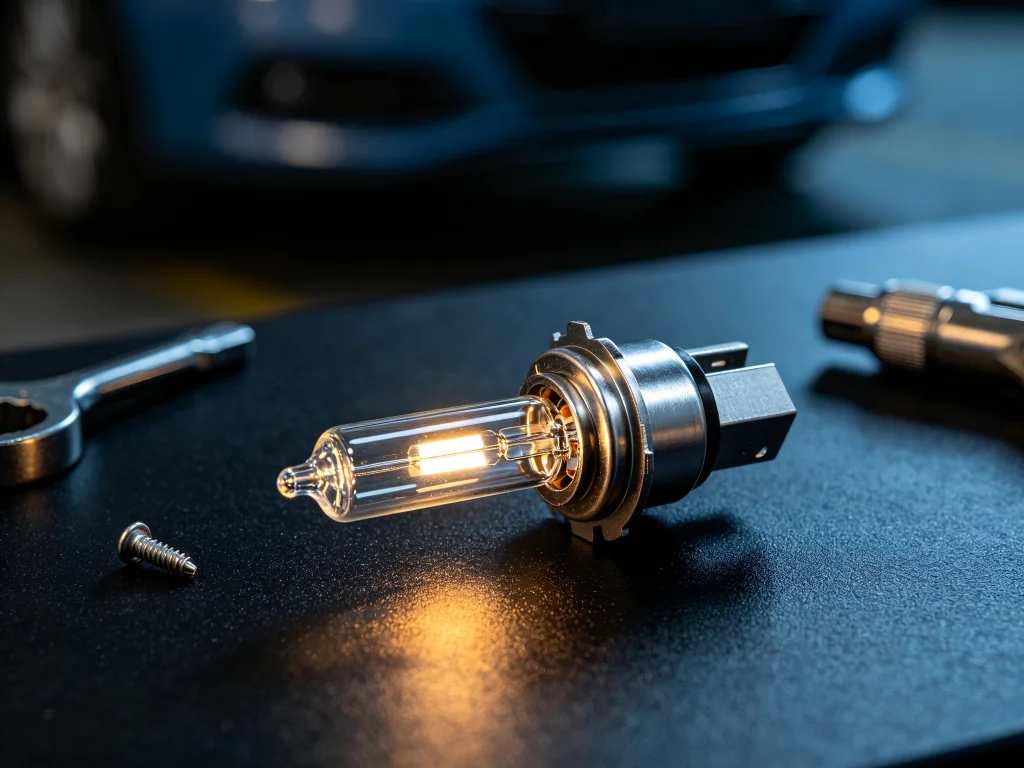
What Does “H7” Actually Tell You?
H7 identifies a bulb format and mounting interface, but it does not guarantee that every H7 LED replacement will install or perform correctly in every H7 headlamp. Vehicle-specific retainers, projector optics, rear housing space, electrical monitoring, adapters, and local regulations can all affect compatibility.
This distinction is critical.
Two vehicles can both use an H7 halogen bulb while having completely different headlamp architectures.
Vehicle A may use a simple spring retaining clip.
Vehicle B may use a plastic twist-lock adapter.
Vehicle C may have almost no space behind the bulb.
Vehicle D may monitor the lighting circuit and trigger an error as soon as a lower-power LED is installed.
So a professional catalog should not simply say:
“H7 = compatible.”
It should ask:
“Compatible with which vehicle, which headlamp, which mounting system, and which electrical architecture?”
The H7 Compatibility Ladder: Check These 7 Levels
A reliable H7 LED installation depends on seven compatibility levels: bulb base, mechanical mounting, rear housing clearance, optical focus, electrical communication, thermal operating space, and regulatory suitability. A bulb should pass every relevant level before it is considered a suitable replacement for a specific vehicle.
At GTR, this is the kind of thinking we recommend for professional aftermarket product selection.
| Compatibility Level | Question to Ask | Typical Failure |
|---|---|---|
| 1. Bulb format | Does the vehicle use H7? | Wrong bulb type |
| 2. Mounting | How is the bulb retained? | LED cannot lock into place |
| 3. Housing clearance | Is there enough space behind the bulb? | Dust cap cannot close |
| 4. Optical compatibility | Does the emitter sit in the correct focal zone? | Weak hotspot or glare |
| 5. Electrical compatibility | Does the vehicle monitor the lamp circuit? | Warning, flicker, or shut-down |
| 6. Thermal compatibility | Can the cooling system operate normally? | Heat buildup and output reduction |
| 7. Legal compatibility | Is the retrofit permitted in the target market? | Inspection or road-use problems |
Step 1: Identify the Headlamp Before Choosing the Bulb
Searching for H7 LED bulbs near me or H7 LED bulbs nearby may quickly locate a replacement bulb.
But availability does not equal suitability.
Before choosing an LED, identify whether the H7 position is being used for:
- low beam
- high beam
- fog lamp
- projector headlamp
- reflector headlamp
This matters because each optical system interacts with the light source differently.
A bulb that delivers an acceptable high-beam pattern in a reflector may not create a strong low-beam hotspot in a projector.
Read the Headlamp, Not Just the Vehicle Model
A vehicle model may even use different headlamp systems depending on trim level, model year, factory lighting package, or market.
That is why a professional compatibility database should ideally go beyond:
Brand → Model → Year.
A better structure is:
Brand → Model → Year → Headlamp version → Function → Bulb type → Adapter requirement → CANbus requirement.
This is much more useful for distributors building serious vehicle application coverage.
Step 2: Inspect the H7 Retaining System
One of the strangest H7 installation problems happens when the bulb is technically correct but physically cannot be secured.
The reason is often the holder.
Some headlamps hold H7 bulbs with a metal spring. Others use removable plastic or metal adapters. Certain installations may require a replacement retaining ring designed around the LED body.
This is not unusual. Even major lighting manufacturers publish vehicle compatibility tables that specify different connector rings for different vehicles.
Three Questions Before Installation
- Can the LED mounting collar be removed?
- Can the original retaining mechanism secure that collar?
- If not, is a vehicle-specific H7 adapter available?
If the answer to question three is no, the installation may become a workshop improvisation.
That is exactly what a professional distributor should avoid.
Step 3: Measure the Space Behind the H7 Bulb
This is where online product photos can be deceptive.
A large aluminum heat sink can communicate “power.”
A large external driver can communicate “professional electronics.”
Inside an actual headlamp, however, every extra millimeter can become a problem.
The Hidden Geometry Behind the Headlamp
Measure at least four areas:
| Measurement | Why It Matters |
|---|---|
| Rear bulb length | Determines whether the dust cover can close |
| Heat-sink diameter | May interfere with brackets or housing walls |
| Driver dimensions | Determines where electronics can be positioned |
| Connector clearance | Prevents cable pinching and poor connections |
A compact H7 LED design may therefore have a major practical advantage even if another product claims more power.
Installation convenience affects more than the person fitting the bulb.
For a chain of retrofit shops, five extra minutes per vehicle can become hundreds of labor hours over a large installation volume.
Step 4: Treat the Headlamp Like an Optical Machine
The LED should not simply “shine into” the headlamp.
It must feed light into an optical system designed around a specific source position.
This is where many high-lumen replacement bulbs lose their advantage.
The Focal Point Is the Real Battlefield
Imagine moving the filament of an H7 halogen several millimeters away from its intended position.
The bulb would still illuminate.
The headlamp would still appear bright.
But its beam could change dramatically.
The same principle applies to LED replacement bulbs.
Important variables include:
- distance from the mounting flange to the LED chips
- size of the light-emitting area
- board thickness
- chip position on both sides
- rotational orientation
H7 LED Bulbs for Projector Headlights Need a Different Test
For projector headlights, judge H7 LED bulbs by focal accuracy, hotspot strength, cutoff quality, and beam distribution rather than apparent brightness at close range. A projector can magnify small errors in emitter placement, causing a bright-looking bulb to produce weak distance illumination or an uneven beam.
A projector is essentially a controlled optical package.
Light from the source is collected, shaped, blocked in specific zones, and projected through a lens.
That process can expose poor emitter placement quickly.
The Garage-Wall Trap
Many drivers test headlights by parking several feet from a wall.
They see an intense white patch and assume the upgrade is successful.
That test can reveal obvious alignment problems, but it does not tell the whole story.
A stronger evaluation asks:
- Is the cutoff stable?
- Is the hotspot where the headlamp expects it?
- Does the beam maintain useful intensity farther ahead?
- Is there excessive foreground illumination?
- Is stray light appearing above the intended cutoff?
For an importer selecting H7 LED bulbs for projector headlights, beam photography and controlled comparison testing are more useful than another line in a specification table.
Step 5: Diagnose CANbus Before Calling the Bulb Defective
A bulb-out warning does not necessarily mean an LED has failed.
LED lighting can present a different electrical load from the original halogen lamp. Some vehicle monitoring systems may interpret that change as a fault.
This is why searches for H7 LED bulbs CANbus error free and H7 LED bulbs with CANbus are so common.
“CANbus” Is Not a Magic Sticker
The phrase “CANbus compatible” is widely used in automotive lighting marketing.
But compatibility should be tested by application.
One vehicle may run the LED with no warning.
Another may show a bulb-out message.
A third may produce flicker.
A fourth may need additional electronics.
Philips also publishes specific CANbus adapter applications for some LED replacement systems, illustrating why accessory requirements can vary by vehicle.
A Better Diagnostic Sequence
- Install the LED and confirm correct polarity and connection.
- Start the engine rather than testing only with ignition power.
- Observe startup behavior.
- Check the instrument panel for bulb warnings.
- Watch for visible flicker.
- Allow the lamp to operate and check for later dimming or shut-down.
- If required, test the correct decoder or CANbus accessory.
This gives installers actual information instead of relying on a universal “error-free” promise.
Step 6: Separate LED Temperature From LED Color Temperature
These two topics are often confused.
6000K refers to the appearance of the light.
It does not describe how hot the LED becomes.
The actual LED semiconductor and driver electronics generate heat while operating, and that heat must be removed efficiently.
Why LED Heat Matters
An LED system can be very efficient while still producing concentrated heat at its electronic components.
If that heat accumulates, the system may reduce operating power or experience component stress.
For this reason, a professional H7 product should be evaluated after it has been operating long enough to reach a stable thermal condition.
A cold-start lux reading can look excellent.
The more useful question is:
What does the bulb deliver after extended operation?
Active Cooling or Fanless H7 LED?
There is no universal winner.
Each architecture solves a different packaging problem.
| Design | Best Feature | What Needs Verification |
|---|---|---|
| High-speed fan | Strong cooling in a compact body | Fan durability and airflow |
| Large passive heat sink | No moving cooling component | Rear housing clearance |
| Flexible thermal structure | Can fit unusual spaces | Correct installation and heat dispersion |
| Compact integrated design | Easy fitment | Thermal capacity at rated power |
The wrong question is:
“Which cooling system sounds more advanced?”
The right question is:
“Can this cooling system keep this particular LED platform stable inside the intended headlamp?”
Step 7: Do Not Assume “H7 LED Bulbs Road Legal UK” Means Yes
An H7 LED bulb should not be described as UK road legal merely because it physically replaces an H7 halogen. Road-use legality depends on the vehicle, headlamp, light source, approval conditions, and current regulations. UK buyers should verify the latest official MOT requirements before converting a halogen headlamp.
This keyword requires careful treatment because search intent and legal reality are not the same thing.
Current GOV.UK MOT guidance states that existing halogen headlamp units on vehicles first used on or after 1 April 1986 must not be converted for use with HID or LED bulbs where this creates an incompatible light source and lamp combination.
For authoritative and current information, check the GOV.UK MOT Inspection Manual.
B2B suppliers should be especially cautious with phrases such as:
- 100% road legal
- legal everywhere
- universal ECE legal LED replacement
- MOT guaranteed
Lighting regulations can vary by country and application.
A responsible manufacturer should help distributors distinguish product performance claims from road-approval claims.
Why “H7 LED Bulbs Philips” Is a Different Search
Someone searching for H7 LED bulbs Philips is often looking for confidence rather than simply light output.
They may value compatibility documentation, known branding, accessory information, and predictable retail support.
That teaches independent automotive lighting brands an important lesson.
You do not compete with a major brand merely by claiming more lumens.
You compete by reducing uncertainty.
What Reduces Buyer Uncertainty?
- clear vehicle application information
- accurate product dimensions
- real beam-pattern evidence
- installation guides
- adapter recommendations
- CANbus guidance
- consistent warranty policy
- stable production quality
That is how a product becomes easier for a distributor to sell.
What Searches for H7 LED Bulbs Amazon Reveal
The keyword H7 LED bulbs Amazon represents another type of buyer behavior.
These buyers tend to face too much choice rather than too little.
They may encounter dozens of products with similar images and radically different lumen claims.
A common listing formula looks like this:
Extreme lumen number + huge percentage brightness improvement + long lifespan claim + CANbus label + easy installation claim.
The specification can look irresistible.
But professional buyers should convert every marketing claim into a verification question.
| Marketplace Claim | Professional Verification |
|---|---|
| “300% brighter” | Compared with what bulb and measured where? |
| “50,000 lumens” | Is this measured bulb output, pair output, or theoretical LED output? |
| “Perfect beam” | In which reflector or projector? |
| “CANbus error free” | On which tested vehicles? |
| “5-minute installation” | Does the vehicle require an adapter? |
| “Long life” | What thermal and cycling tests support the claim? |
What Searches for H7 LED Bulbs Halfords Tell Us
Searchers using phrases such as H7 LED bulbs Halfords or H7 LED bulbs near me usually want a fast solution.
They may have a failed lamp, an upcoming journey, or a vehicle already sitting in a workshop.
This creates a different product requirement:
clarity.
The buyer needs to know quickly:
- Is H7 the correct bulb?
- Will it fit?
- Do I need an adapter?
- Will it trigger a warning?
- Can it be used legally?
- Can I install it without modifying the headlamp?
A distributor that answers those questions better than competitors may convert more buyers even without offering the lowest price.
A 10-Minute H7 LED Sample Audit for Distributors
If you are comparing factory samples, you can learn a surprising amount before laboratory testing begins.
Minute 1–2: Inspect the Emitter
Look at chip arrangement and PCB thickness.
Ask whether the light-emitting position attempts to match the original filament location.
Minute 3: Check the Mounting Collar
Determine whether it is removable and whether its geometry works with common H7 retainers.
Minute 4: Measure the Rear Body
Record length and diameter.
Large differences here can affect real vehicle coverage.
Minute 5: Inspect the Driver
Check whether it is internal or external and consider where it will sit inside the headlamp assembly.
Minute 6–7: Install in a Reference Headlamp
Do not evaluate the bulb in open air alone.
See how it behaves in the optical system.
Minute 8: Check the Beam
Look for cutoff shape, hotspot position, dark zones, asymmetry, and unwanted stray light.
Minute 9: Check Installation Clearance
Confirm whether the rear cover can close normally.
Minute 10: Ask for Evidence
Request thermal data, electrical testing, application information, and production QC details.
You now know far more about the product than a giant lumen number could ever tell you.
The Distributor Test: Can Your Sales Team Explain the Product?
A technically good bulb can still fail commercially if salespeople cannot explain where it fits.
Imagine two H7 products.
Product A has an attractive package and an enormous brightness claim.
Product B includes:
- vehicle application guidance
- adapter information
- clear CANbus notes
- dimensions
- installation instructions
- beam evidence
- structured after-sales support
Which one is easier for a regional distributor to build into a long-term product line?
Usually, the answer is not determined by lumens.
It is determined by how many problems the supplier has already solved before the product reaches the installer.
Where GTR Fits Into the H7 LED Supply Chain
GTR serves the automotive aftermarket with a manufacturer-oriented approach to lighting development.
For us, H7 LED development is not just a matter of combining LED chips, an aluminum body, and a driver.
The product must eventually enter a real vehicle.
It will be handled by a distributor.
Sold by a dealer.
Installed by a technician or customer.
Used inside a specific headlamp.
Driven for long operating cycles.
And judged by the light it puts on the road.
That entire chain matters.
What Professional Partners Can Discuss With GTR
Depending on project requirements, B2B conversations may include:
- H7 LED product selection
- projector and reflector applications
- target vehicle coverage
- compact fitment requirements
- CANbus solutions
- OEM and ODM projects
- private-label packaging
- regional product positioning
- aftermarket distribution programs
H7 LED Bulbs: Fast Answers Before You Buy
Can all H7 halogen bulbs be replaced with H7 LED bulbs?
No. H7 identifies the bulb format, but mechanical fitment, headlamp optics, electrical compatibility, space, and road-use rules still need to be checked.
What are good H7 LED bulbs for projector headlights?
Prioritize accurate emitter positioning, controlled beam distribution, strong hotspot performance, compact installation dimensions, and thermal stability. Test the bulb in the intended projector rather than relying only on lumen output.
What does H7 LED bulbs CANbus error free mean?
It generally describes a product designed to reduce common dashboard warnings or electrical compatibility problems. However, no simple label should replace vehicle-specific testing.
Do H7 LED bulbs with CANbus need an external decoder?
Some vehicles may operate correctly with the integrated electronics, while others may require additional adapters or decoders. The requirement depends on the vehicle’s lighting control system.
Are H7 LED bulbs road legal in the UK?
Do not assume that an H7 LED retrofit is legal simply because the fitting matches. For many vehicles originally equipped with halogen headlamp units, current UK MOT rules restrict conversion to an incompatible LED light source. Always check current official requirements.
Are Philips H7 LED bulbs universal?
No. Even established manufacturers use vehicle compatibility lists, connector rings, and CANbus accessories for specific applications. Bulb type alone does not establish complete compatibility.
Should I buy H7 LED bulbs from Amazon?
Marketplaces offer extensive choice, but compare optical design, fitment, thermal behavior, electrical compatibility, seller support, and evidence behind performance claims instead of selecting by headline brightness alone.
How can I find H7 LED bulbs near me?
Local automotive retailers, lighting specialists, retrofit shops, and online store-location searches can help. Before purchase, confirm the exact headlamp application and any adapter requirements.
The Best H7 LED Starts With the Car, Not the Box
The automotive lighting industry has trained buyers to compare numbers.
More lumens.
More watts.
More cooling fins.
More LEDs.
More marketing.
But a headlamp does not read the packaging.
It only responds to physics.
The emitter either sits in the right optical position or it does not.
The bulb either fits behind the dust cover or it does not.
The electronics either communicate properly with the vehicle or they do not.
The cooling system either controls temperature or it does not.
The final beam either helps the driver see or it does not.
That is why professional H7 purchasing should begin with application engineering.
If you are building an H7 LED range for automotive wholesalers, lighting distributors, retrofit chains, or your own aftermarket brand, send GTR the vehicles and market applications you want to cover—not just a target lumen number. Explore professional automotive lighting and OEM/ODM opportunities at www.rhgtr.in and build your next H7 program around real-world fitment.
[1]: https://www.gov.uk/guidance/mot-inspection-manual-for-private-passenger-and-light-commercial-vehicles/4-lamps-reflectors-and-electrical-equipment?utm_source=chatgpt.com “MOT inspection manual: cars and passenger vehicles”
[2]: https://www.philips.com/c-dam/b2c/category-pages/lighting/FAQ/Philips_LED_upgrade_car_compatibility_list-20.pdf?utm_source=chatgpt.com “Philips LED upgrade car compatibility list”